The English major who became an accidental zookeeper
SINGAPORE: When Ms Delvinder Kaur signed up for a stint every bit a show presenter at the Singapore Zoo in 2013, she expected nothing more than a fun holiday task of playing with animals and speaking to visitors before moving on to exercise her university caste.
Fast forrard half dozen years, Delvinder, 28, hopes to retire in the zoo.
"I've seen a lot of my seniors who accept retired here, and even later retiring, they notwithstanding come back. You run into the passion, and I remember that's the same passion that I would want in myself as well," she said.
The Life Scientific discipline Acquaintance is just one of the many zookeepers who joined the Singapore Zoo without a related degree.
"Like virtually young kids at that point in time, I was just looking for a fun job, something that was only out of the ordinary, and Singapore Zoo was ane of the areas," she said.
Evidence presenting gave her the opportunity to work with a variety of animals, such as sea lions and elephants, and develop her understanding of them. And it was this understanding that allowed her to appreciate the animals a lot more.
In fact, she enjoyed her post-A levels holiday task so much that she never stopped.
"I fell in honey with the task," she said, "and I dragged information technology on a bit longer to notice out what it is that I wanted to practice."
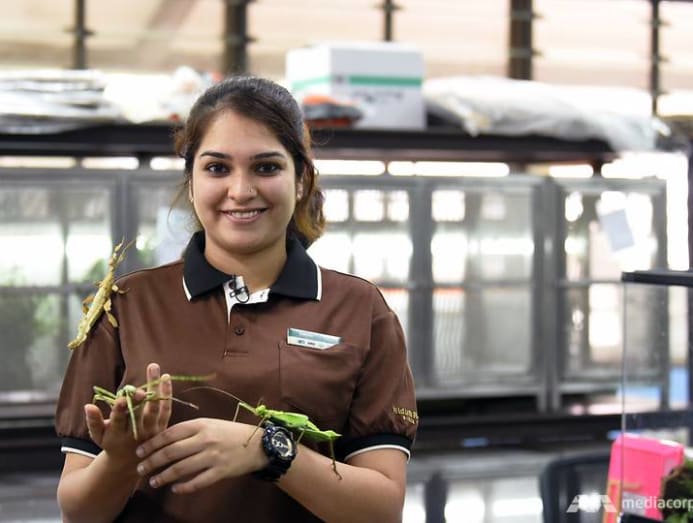
A few months turned into another iii years earlier she decided to continue the studies that she had put on hold.
In 2015, Delvinder moved from being a show presenter to the zoology department, where she got her offset taste of working with invertebrates - specifically, insects.
She explained that she plant the classification of animals - the unlike species and subspecies - one of the nearly challenging things about the chore initially.
"I recall not being from a life science background, zoology background, did make it a flake difficult initially … simply the thing about Singapore Zoo and existence a zookeeper, a lot of things happen with on-the-job training.
"Beingness on the field and working with different teams and with the guidance of your seniors, it allows you to develop the needed skills to manage and take care of animals and to understand the animals we have under human care as well," she said.
All the guidance and difficult work paid off when she managed to movement from her part-fourth dimension position to a total-time inferior zookeeper position in 2016. At the same fourth dimension, she started her English Language and Communications degree with the Singapore University of Social Sciences, which she is due to complete in a year.
"I feel like I grew upward in the zoo. I became a bit more than mature in this environs, because I understand information technology a bit more," she said.
"It maybe started off every bit something very childish, (only) it's something more important and valuable to me at present - it'southward a greater cause."
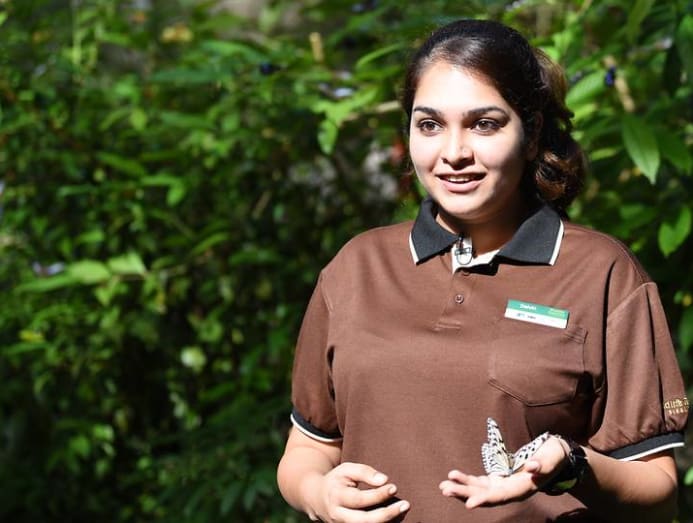
NOT Only A Concrete JOB
Delvinder is one of an increasing number of female zookeepers who acceptjoined Wildlife Reserves Singapore in the past decade.
Currently, 78 out of the 246 keepers under the zoo'due south employ are female - including the first female person elephant keeper.
Although zookeeping was traditionally thought to be more suited for a man, Delvinder felt this stemmed from a lack of understanding over a zookeeper's work.
"I think it's a common misconception that zookeeping is a masculine task, that it's a man'due south chore and you have to carry heavy items and there'south a lot of piece of work and effort that goes into information technology," said Delvinder.
That was one of the main worries her parents had too, she added, every bit they didn't understand the job telescopic.
"It took me three years to convince them that the job was alright and this is the field that I wanted and I got my blessings from them," she said.
Zookeeping encompasses more than just caring for the animals. Other than zoology, there are departments such every bit conservation, nutrition, veterinary - which work closely to ensure the zoo functions smoothly.
At that place is as well a inquiry component to Delvinder's work, ane that she has earned accomplishments in. She contributed toa pioneering study on the breeding of Dragon-Headed Katydids, a type of invertebrate, published by Wild animals Reserves Singapore.
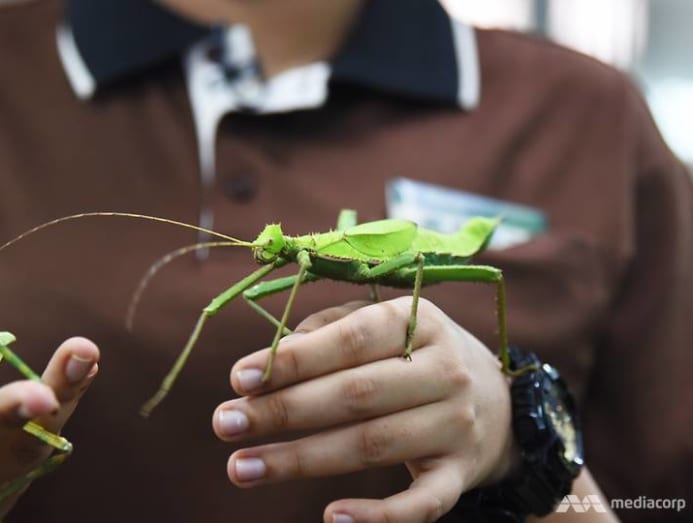
Ultimately, all this research helps with conservation of these animals and public education.
"Animals in zoos are representations of their wild counterparts. We accept them in zoos under homo care (which allows us) to view them upwards close, to learn more about them, and besides to run across them, appreciate them, and empathise what we tin do for those out in the wild," she said.
She added that conservation begins with the smallest projects. Even actions like understanding the office of bees in the ecosystem and leaving a beehive alone to perform its natural functions would assistance wildlife thrive.
Especially since invertebrates are such commonly misunderstood animals, public education is crucial to changing the public's mindset of them, said Delvinder.
"A lot of people, they desire to help, they like the idea of having more butterflies … of having more invertebrates around, merely they don't know how to go downward that track," she said. This is where the zoo's educational programmes come into identify.
She pointed to the zoo's Swallowtail Twenty-four hours held this year, where members of the public were invited to join them to await for the butterflies. Not merely did the activity teach participants about Swallowtail collywobbles, the effect closed with a sharing sessions with specialists, who taught participants near the things they could practise to help the conservation of the species, she said.
"Basically, zoos play a very important role in terms of education, conservation, and having good homo care for the animals," said Delvinder.
"WHEN THE BEES Die, Nosotros Die"
In her solar day-to-day duties, Delvinder looks afterwards the wellbeing of all the invertebrates in the zoo. This includes monitoring the exhibits, back-of-firm breeding facility. She also takes on projects.
She is currently working on the Pollinator Project which focuses on improving the population of collywobbles and stingless bees through surveys of these species beyond all of Wildlife Reserves Singapore's parks, studying unlike potential habitats, and enhancing existing ones.
While Delvinder exudes confidence and is knowledgeable well-nigh invertebrates now, this was not always the case.
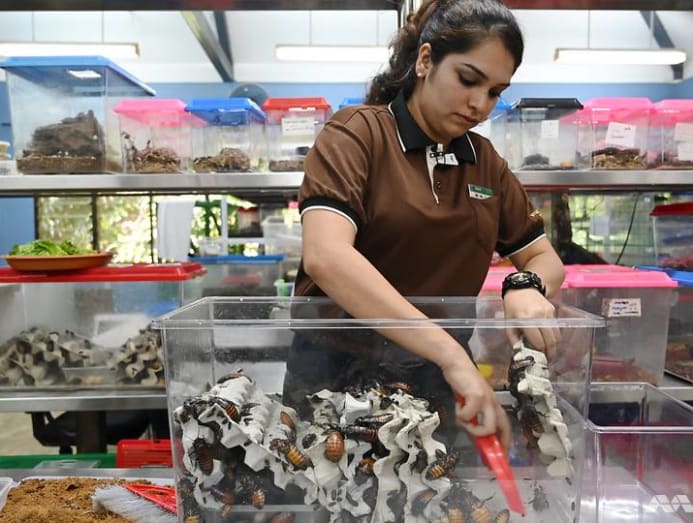
When she started her posting with the invertebrates, she remembered having to come face-to-face up with 1 of her greatest fears: the Madagascan Hissing Cockroaches.
With some of them almost half a palm in size, these black-headed, brown-bodied, segmented creatures tin can scurry through the tanks at a dizzying pace. Each tank can hold up to a few hundred cockroaches - although Delvinder remembered her first tank being four times the size.
"I had to clean the whole tank full of cockroaches, and that was my outset day working as an invertebrate keeper.
"As yous can see, y'all can imagine the cockroaches were scurrying all around … Every time I put my hand in and the cockroaches scurry over, I would freak out and remove my hand from the tank," she said.
It took her about a week to get over her fear, but having the opportunity to acquire about these cockroaches, to sympathize them, and to hold her commencement cockroach, was crucial in getting over her fear, she said.
Information technology is ignorance that causes people to fearfulness invertebrates so much, said Delvinder.
"It shows equally well, that when we don't really understand the animals, nosotros tend to stigmatise them, and that tin as well affect our outlook on them. So information technology'southward something that I've learned, and I'm also helping others to acquire it too," she said.

In fact, invertebrates play a larger function than most people might wait: comprising 97 per cent of the beast kingdom, they are of import for the continued survival of all animal species on Earth, shesaid.
"There'south a line: 'When the bees die, we die,'" said Delvinder. "It says a lot already. In a way, it'due south a domino effect. Once the bottom foundation layer starts to go, everything else will continue as well, because not simply are you taking the main runners of the ecosystem, you're too taking abroad those who maintain the rainforest, you lot're also taking away the food for the other animals."
"SOMETHING THAT I DON'T THINK I Always REGRET"
Looking back, Delvinder finds the learning the near rewarding function of her job.
"For me, information technology'south always the ability to learn something new. Every time we learn something new, we can apply information technology in a certain style, and (invertebrates) is an expanse which I personally think is very understudied.
"At that place'south and so much that we should acquire … So being able to play a part in that and working with the other members of my internal and external squad is one of the virtually rewarding things for me," she said.
And it's this desire to larn, to contribute, and to work with these animals that continues to drive this accidental zookeeper.
"You lot don't realise it the moment you walk in - it takes a bit of time to sympathize why we're doing this, what do we leave of it, and how (our piece of work) is helping … (I do this) because of my appreciation and understanding, and what I think the future should exist for these animals," she said.
Reflecting on her unconventional path, Delvinder said: "Information technology'southward something I don't think I ever regret. It's gotten me to this stage right at present.
"It's feel that sometimes Singapore is a bit likewise fast-tracked, and we need to stand back and empathize what nosotros're interested in, and for me, permit me to develop my passion equally well."
Source: https://cnalifestyle.channelnewsasia.com/singapore/english-major-who-became-accidental-zookeeper-231926
0 Response to "The English major who became an accidental zookeeper"
Post a Comment